

Birthplace of The Open – Part 1
Prestwick – Birthplace of The Open
Created in the days when golf professionals were also ball and club makers and greenkeepers like Old Tom Morris, The Open Championship was first played in 1860 at Prestwick on the Ayrshire coast of Scotland. The where and when might be fixed in many minds, but the why is not so well known.
In September of 1859 when Allan Robertson, the undisputed best golfer of his time, died at the age of 44 a few months after an attack of jaundice, it was agreed that a tournament would be held to determine who would replace Robertson as the “Champion Golfer”.
The members of Prestwick Golf Club (founded in 1851) paid £25 to commission a red Moroccan leather belt with a richly engraved silver buckle. It was designed to be the prize for the first Open Championship, and was a stunning trophy indeed. Every bit as regal as a crown, this highly ornamental piece of paraphernalia must have imbued its wearer with a very deep visceral feeling of accomplishment.
It was, to say the least, a very tantalizing prize. Wearing it would certainly symbolize one’s supremacy and would without a doubt, add an aura of personal glory to the triumphant golfing gladiator.
Willie Park, Sr. of Musselburgh claimed the prize with a score of 174 over 36 holes, which meant going around the course three times since Prestwick was just 12 holes back then. Old Tom Morris, who created this layout, was one of eight golfers in the field. But even with his intimate knowledge of these twelve holes, he lost to Park by two strokes.
The first winners of the Open Championship
The Open Championship was held at Prestwick every year for the next ten years and was won by Tom Morris, Sr. four times, Willie Park, Sr. two more times, Andrew Strath once, and Young Tom Morris three times.
 When Young Tom won the belt three times in a row (1868, 1869 and 1870) it was his to keep forever as stipulated in the conditions of the competition. He actually won The Open four consecutive times, but since he already owned the magnificent Challenge Belt and a new trophy was not organized in time, the competition was cancelled in 1871. Imagine…cancelled. Wouldn’t happen today of course over lack of a trophy. A world war, yes, but a trophy, I don’t think so.
In 1872, when Young Tom won The Open again, which was held at Prestwick, he was awarded a commemorative medal. Since he already owned the mother of all belts, maybe he was content. But it seems a shame that he didn’t get to hold the now-coveted silver Claret Jug in his worthy hands, and keep it for a year, as is the custom now.
The new trophy was jointly paid for by Prestwick, the Royal and Ancient Golf Club of St Andrews and the Honourable Company of Edinburgh Golfers. The handsomely decorated silver jug, officially named the Golf Champion Trophy was made by Mackay Cunningham & Company of Edinburgh at a cost of £30, and was hallmarked in 1873.
 The winner of the 1873 Open Championship, Tom Kidd, was the first to receive the new trophy, but there must have been some consolation for Young Tom, because his name was the first to be engraved on it.
Prestwick went on to host The Open 12 more times between 1875 and 1925 with 1884 being the year the competition was staged over two rounds of 18 holes, since the course had been expanded in 1882. In all, Prestwick hosted The Open 24 times, which is second only to the Old Course in St Andrews, which was the venue for the 28th time in 2010.
Only The Open Championship is The Open
Perhaps now you understand why I always refer to this, the oldest of the four “Majors”, as The Open or The Open Championship rather than calling it the British Open. In fact, not only was this tournament created in Scotland, and staged in Scotland until it was played at Royal St George’s in England in 1894, the Champion Golfer right through 1889 was Scottish until the competition was won by John Ball, an English “amateur.”
The U.S. Open is not The Open. The Phoenix Open is not The Open. Only The Open Championship is The Open. Now that we have settled that, here is the rest of the story.
I had a pretty good working knowledge of the history of Prestwick, so it engendered enormous respect and instilled great anticipation the instant Kevin asked me if I would like to go there.
We had plans to be in St Andrews later in the week, so we tacked on a couple of extra days at the beginning of our trip, which meant we played Prestwick the same day we took the ferry over from Ireland. I was truly looking forward to it for months. Well, maybe years.
Ah, the Ailsa Craig
About the time the Ailsa Craig came into view, we were motoring north along the windy scenic road headed up the western coast toward the famous Turnberry Resort and Prestwick just 35 minutes farther on.
Ah, the Ailsa Craig. There is something magical about this monstrous mound that looks rather like the top of a bald giant’s head, submerged to allow only his watchful eyes to survey and protect the ancient land now known as Scotland.
 The Ailsa Craig climbs out of the Firth of Clyde, and is a volcanic island that is presently uninhabited except for large colonies of gannets and puffins. Even using the power of the zoom on my Nikon camera, I could barely make out the lighthouse and the ruins of the 16th century castle.
The lighthouse was built in the late 1880s and used oil-burning lamps in those days. It was automated in 1990 and then converted to solar electric power in 2001. No further need for a lighthouse keeper then, since the birds could always find their way back to their home with their internal GPS.
The massive domed rock appears to be anchored to the center of the earth. At times, it looks like a colossal blue cabochon gemstone, resting in its watery setting, nearly ten miles from mainland Scotland. It is a stone alright. The very meaning of the word craig (or the Scottish Gaelic creag) is stone.
Along with being an iconic landmark situated about the halfway point in the sea journey between Belfast and Glasgow, the island is known for its blue hone granite, which has been quarried since 1851. Apparently it is one of only two sources for all stones used in the sport of curling—the other being the Trefor Granite Quarry in Wales.
Further research revealed that the last “harvest” of the Ailsa Craig granite took place in 2013. The 2,000 tons that were quarried are thought to be sufficient to fill orders until at least 2020. So if you’re in need of a blue hone curling stone or two, and you’re not on the list, you are in for a long wait.
Maybe it is the blue hone granite that seems to infuse the monumental mound with a blue glow or haze. That is, when you can see it.
The Scots have a saying:
If you can see the Ailsa Craig, it’s going to rain.
If you canna (cannot) see the Ailsa Craig, it’s raining.
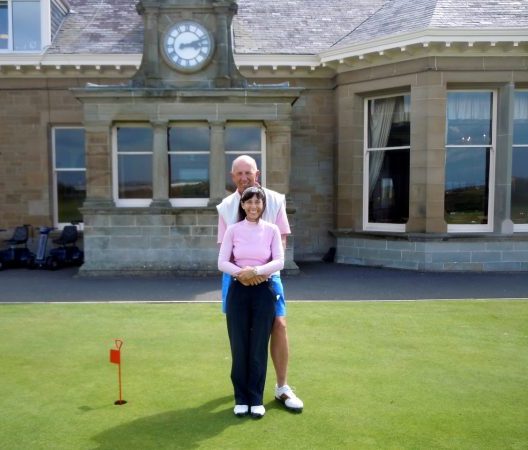
The moment we rolled into the car park beside the Prestwick clubhouse, I hopped out to get a photo. I was eager to capture this and every moment of being here, at the very birthplace of The Open Championship. Like my first time at the Louvre, it was love at first sight.
A VIP tour with Ken Goodwin
Our visit was made ever more special when Ken Goodwin, the club Secretary, graciously offered to give us a VIP tour upstairs and down to point out many items in their vast collection of artifacts and memorabilia. This included treasures like a number of Tom Morris golf clubs and even Morris’ winning scorecard from the 1864 Open, plus all the scorecards up to 1875.
Another special item on display is the ball that James Braid used when he won The Open in 1908. He sent it to the Prestwick Member who was his marker for the tournament along with a cover letter. It was Braid’s fourth of his five Open championships. He was surpassed only by Harry Vardon, who won a record six Opens, the last being in 1914.
Just moments after we came through the ultra contemporary glass entrance and stowed our golf shoes away in lockers, Ken began by telling us, “For our 150 year anniversary of The Open Championship (2010) we received gifts from clubs all over the world!”
There was an endless array of framed prints from all the most famous and prestigious clubs with congratulatory messages inscribed on brass plaques.
We followed Ken up the green-carpeted central staircase and he proudly pointed out through a window and enthused, “From here you can see the seventeenth hole which was once the original second hole!”
Ken was enjoying our utter amazement, and delivered the most astonishing fact of all: “And there are still six original greens in play today.” Clearly, he knew every square inch of this historic golfing ground, as if he had built the course himself.
 In the middle of our ebullient mood, though, there was one sad moment. Ken took us into the Members Card Room. He pointed out a photo of Lady Diana, Princess of Wales, hanging on the wall by a round table and four chairs. I was already choked up when I said to Ken, “It is such a surprise to see a photograph of Lady Di here.”
Ken nodded. “She was at an event nearby and had been invited to visit the Club.”
He placed a hand on one of the green leather chairs, and in a very solemn and thoughtful manner added, “She sat here at this table when she signed our guest book but we don’t know which chair she sat in.” It wouldn’t have been so important at the time, but certainly now, anything she touched would have been cherished and held very dear.
After a few moments to gather ourselves, the tour continued. “This is the old Smoking Room,” Ken informed us, “where you would need to wear rather formal attire to go in.
“Of course it is still called the Smoke Room, and the men still have to wear jacket, collar and tie,” Ken raised an eyebrow, “but we don’t allow smoking any more.”
Later on we learned what has now become a bit of the Prestwick folklore. Apparently, the day before the ban back in 2006, the members in a single act of defiance, staged a smoke-a-thon! The smog was so thick it blanketed the room clear up to the rafters. Someone remarked, “They practically needed the old decommissioned Ailsa Craig foghorns to find the members floating around in a sea of smoke.”
Ken did also point out, “Although smoking is banned in the Clubhouse, we do still retain the brass ashtrays and pipe and cigar ashtrays on the tables. They were made from the end of World War I naval artillery shell cases.”
Once again, I was rather dumbstruck. Here the Scots demonstrate in a remarkable and clever way how ingenious and resourceful they are, while at the same time providing a sobering reminder of the 700,000 Scottish soldiers who joined the forces to fight in the First World War.

It was long past lunchtime, but Ken proceeded to show us the formal Dining Room. Top to bottom hung dozens of pictures of various dignitaries associated with Prestwick. The dark green painted walls, elaborate white crown moulding and rich wood-paneled wainscoting harkened back to earlier times where as many as thirty-two people would be seated for a grand meal at the long mahogany table. I’m sure the claret wine and genial banter flowed generously.
READ MORE – Part 2

Birthplace of The Open is the first story in Taba’s newly published Golfers, Scotland Is Calling


 Kevin reveled in the sweet memory. “Twelve pars and five birdies for those seventeen holes was as good a game of golf I had ever played in my whole life.”
 But then Kevin perked up and said, “I’m happy to say that several years later, when all of the aging regular rascals who participated in this event, decided the tournament should just be one round, I shot a 1 under par gross 70, this time off a 5-handicap.”
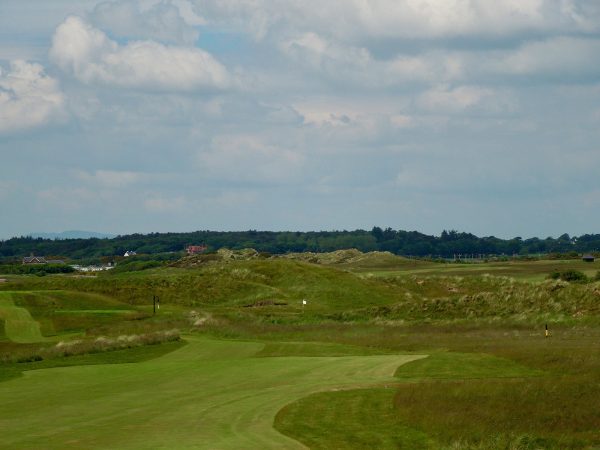 Just about every other hole Kevin said, “The greens seem much larger,” or “This hole is much longer than I remember it.” Like in the story Kevin told me earlier, he is clearly one of those guys whose brain is wired to remember every shot he ever hit on every course he’s ever played; and he’s probably right. Not that Kevin is playing the championship tees, but the course has been stretched to 6,908 yards.
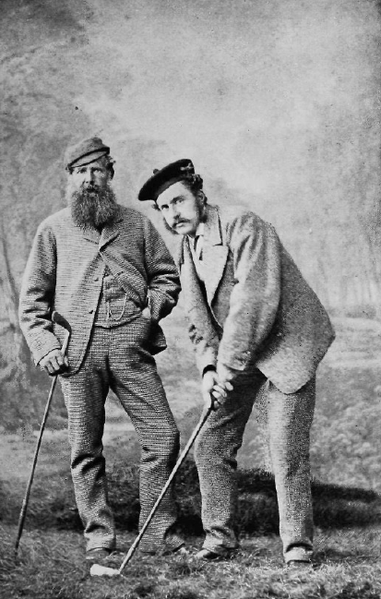 And may I further point out that Young Tom played in his first Open at age 14. Young Tom’s first Open Championship win, in 1868 at age 17, made him the youngest major champion in golf history, a record which still stands.
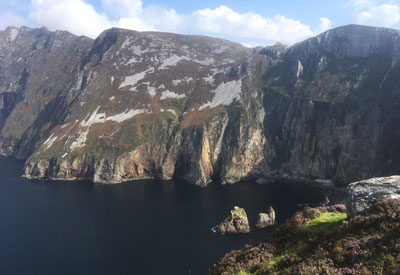 These are the highest cliffs in all of Ireland. Although one of Ireland’s best kept secrets, they rise almost three times higher than the Cliffs of Moher — nearly 2000 feet. I had never heard of them. Astonishing.
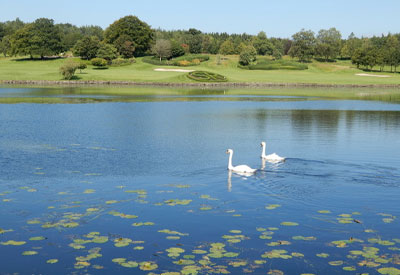 Our first destination was County Cavan so that Kevin could play in the Ulster Seniors Golf Championship. The 2020 venue was Slieve Russell Hotel Golf & Country Club on their fine parkland course. We had a sumptuous room with a view of the rose garden and 18th green. To make everything more delightful, we had warm sunshine. Perfect weather and great camaraderie, unfortunately did not add up to a winning score for Kevin. In spite of those 3-putts on the tricky greens, we both thoroughly enjoyed the luxurious experience.
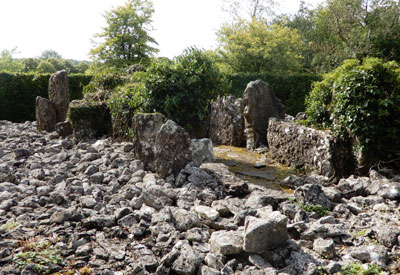 But it was the amazing prehistoric monument hiding in the Secret Garden that absolutely blew me away. It is called the Aughrim Wedge Tomb. It was originally located on the slopes of the Slieve Rushen mountain. The Quinn Group, who built the hotel, were quarrying there when it was unearthed. They engaged Mr. John Channing, Archeologist, to oversee the excavation in 1992. It was then carefully reconstructed on the grounds of the hotel rather than have it disappear forever. To some, it may be sacrilegious to move what the local folklore call “The Giant’s Grave”, but the trade off is, many more people will see it and have a peek at the ancient past of this part of Ireland.
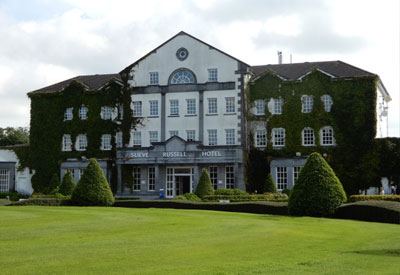 The entire hotel property is situated about 85 miles northwest of Dublin. Many would regard it as the middle of nowhere. Our antiquated GPS took us on a network of single track roads. The grass growing down the middle, shall we say, tickled the bottom of our low-slung BMW sedan. By the time we reached the Slieve Russell Hotel, for us, it did feel like it was light years away from anything resembling a city. In other words, purely idyllic.
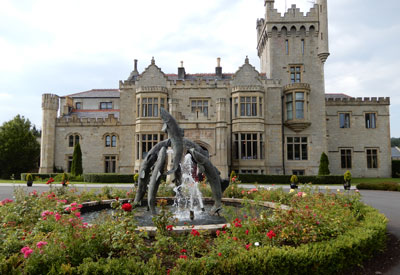 Knowing that Kevin and I are the leaders of this group, the hotel management put us in a magnificent suite. We were barely in the door of our luxurious light-filled cocoon, when we spotted the chocolate covered strawberries. After quickly stashing our suitcases, we smuggled the strawberries over to The Gallery Bar, where we sat outside in the glorious sunshine and enjoyed them with a lovely glass of perfectly chilled Prosecco. Well, I did. I think Kevin had a shandy.
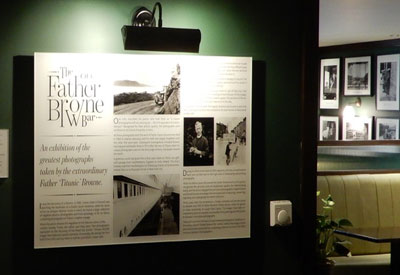 I may know fine art, fine framing and expert placement of a large photographic collection, but I was completely humbled by not having a clue to who is this artist. Although Father Francis Browne, a Jesuit priest, had died in relative obscurity in 1960, when his work was discovered, one critic compared him to the famous French photographer, Henri Cartier-Bresson.
 I was thrilled to be able to show Father Browne’s Bar to Kevin before our dinner. While doing our site visit the next morning with Stephen Bell, the Sales Manager of the hotel, he also showed us an elegant room tucked away off the main part of the bar where we can have a private Welcome Dinner for our guests in July 2021. Then we also have the perfect venue for our musicians to entertain everybody back out in the bar area, while the pints are flowing.
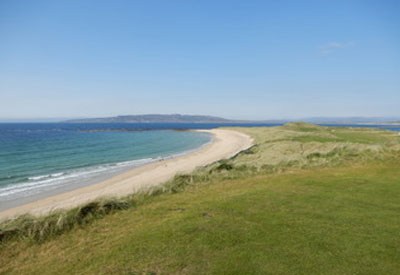 We packed a lot into our five-day trip to Cavan and Donegal — two counties in Ulster. (Ulster is one of four provinces of Ireland. The remaining three are Leinster to the east, Munster to the south and Connacht to the west.) We live in Liscannor near Lahinch, in County Clare. This is Munster. So it was great to see another part of Ireland. It was almost like going to another country.
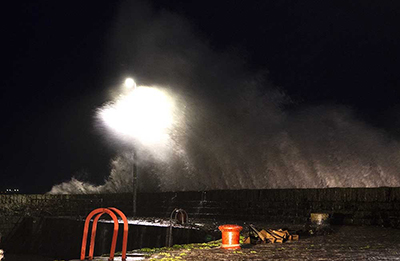 When she did arrive in the dark of the night she brought the entire percussion section of a hundred orchestras with her. Drums of heroic dimensions. Timpani yes, but modest bodhrán, no. Ellen seemed to be trying to find a way to the center of the Earth. She pummeled the whole house, as if we alone stood in her way to the deep underground cave she was seeking.
 The wind is ever-present when you are by the sea. It can be refreshing like it was today, especially while we’re keeping up a good pace going down a quaint, single-track road. It is one of the things I love about our rural part of County Clare, when you come across a road with grass growing down the middle and can feel miles away from anything resembling a city.
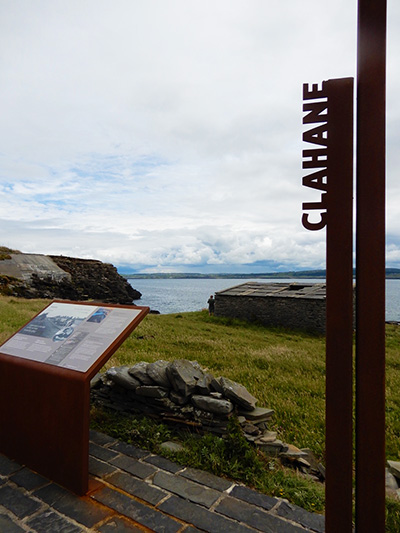 The road bends a bit as we start a slight incline. We are confronted by a stern sign, warning us of Extreme Danger, and suddenly the cliffs are in our view. Mind you, they are modest compared to the Cliffs of Moher, but I’m not going anywhere near the edge. Uh uh. I’m sticking to the wee road.
 Right, a couple of ingenious guys wheeled a truck close to the flaggy shore, and were pumping sea water into a bevy of large wooden barrels – appropriately spaced more than six feet apart – so people could immerse themselves in warm sea baths.
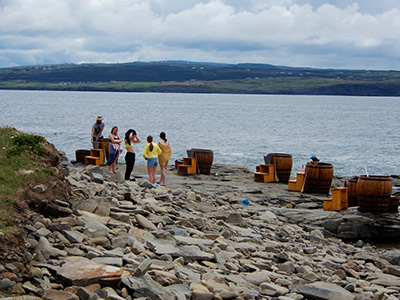 Scientific studies have confirmed that seaweed bathing helps lower body stress and relieve skin conditions (psoriasis, eczema, acne etc). It has also been shown to be beneficial in the treatment of muscle aches and joint stiffness (rheumatism and arthritis), and excellent for some circulatory problems.
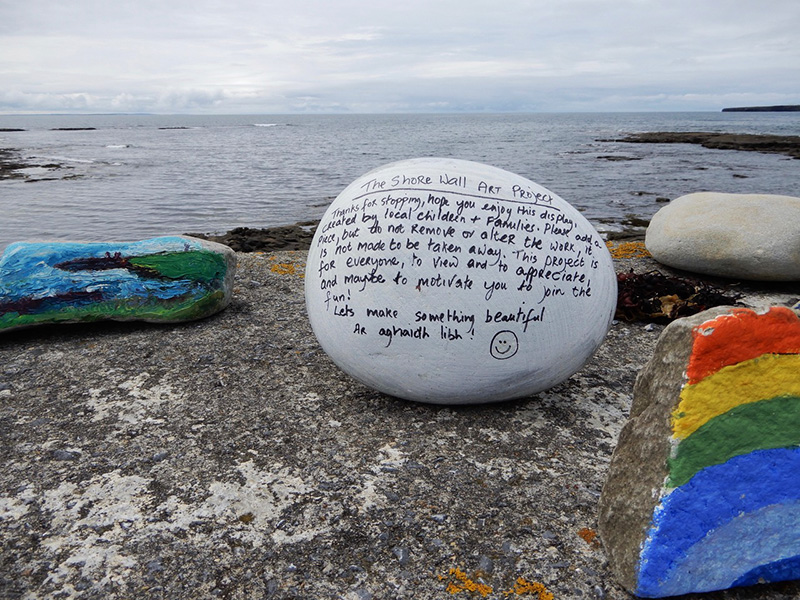
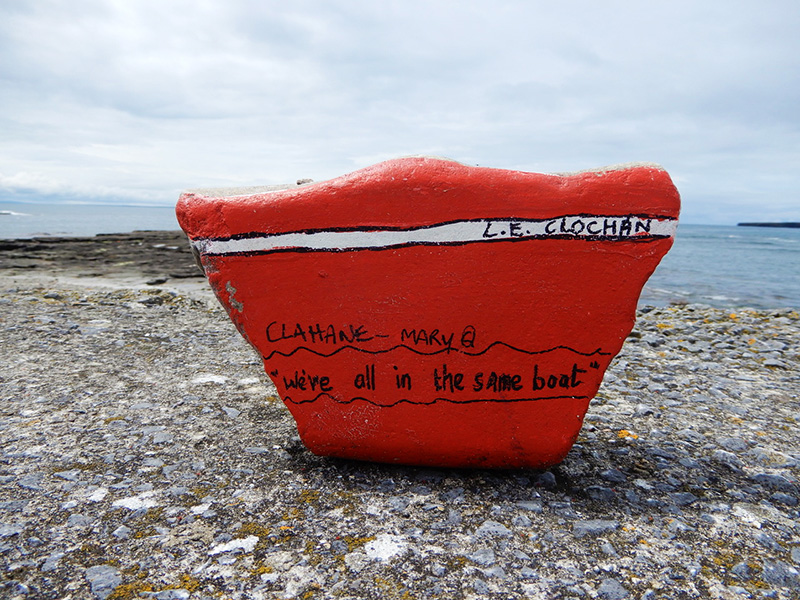

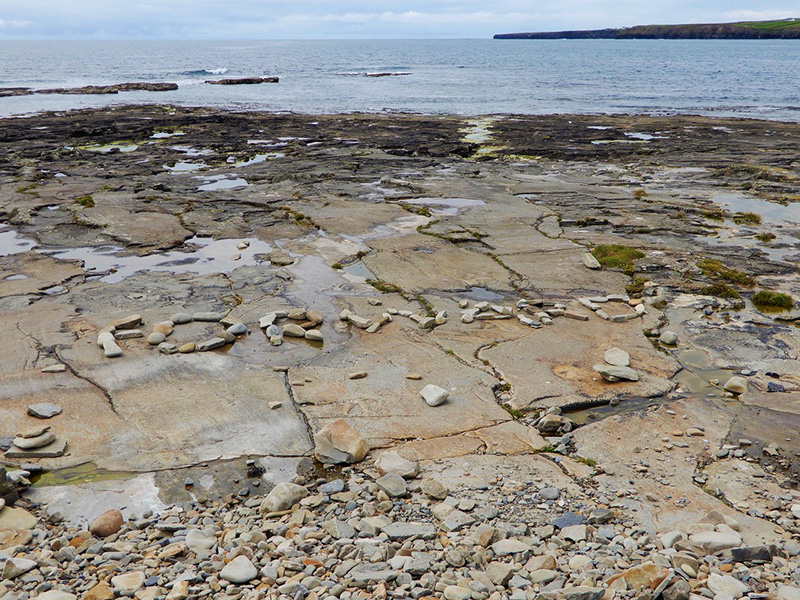
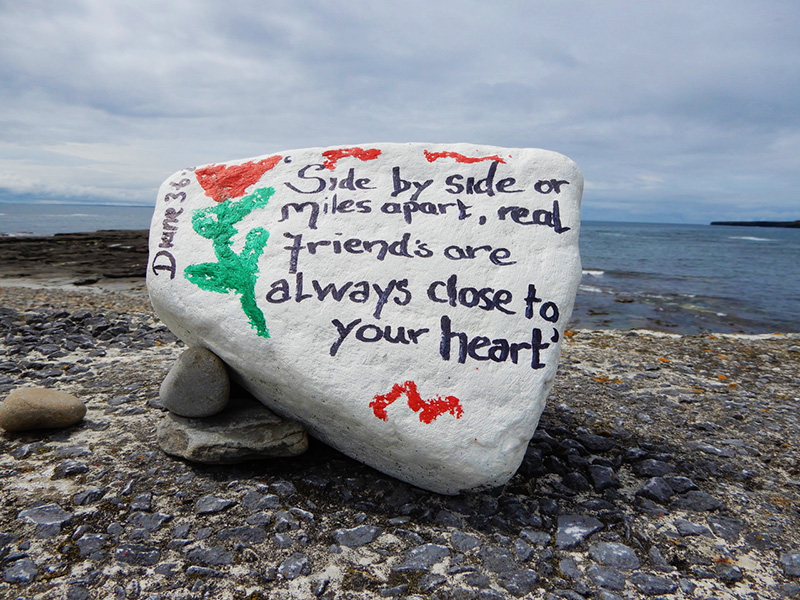
 Clahane (An Clochán) is what the clever marketers call a “Discovery Point” along the Wild Atlantic Way, which stretches 2,500 miles along the coastline of Ireland. We are not far from Lahinch here. Further west, at Hag’s Head is the southern edge of the spectacular Cliffs of Moher, that rise 700 feet above the ocean.


 Having learned some of the history of the bloody Battle of Culloden, which took place on April 16, 1746, I knew how the redcoats of Cumberland’s army bludgeoned the fierce but exhausted Clansmen on the Highland moor near Nairn. Charlie escaped and lived out the rest of his life in Rome, where he was born; but I do not know the details of where he went while on the run.
 But both Kevin and I play white balls and we did not make the adjustment to adapt to the playing conditions of the course. We gave up after playing the first nine and could see from the course map that we could cut across to the 16th hole, then play the last two and find our way back to our car.
 Golf in a place like Askernish is exhilarating and perhaps in equal measure, humbling. It felt like we were playing golf more like it would have been 400 years ago. It was primitive, even.


